
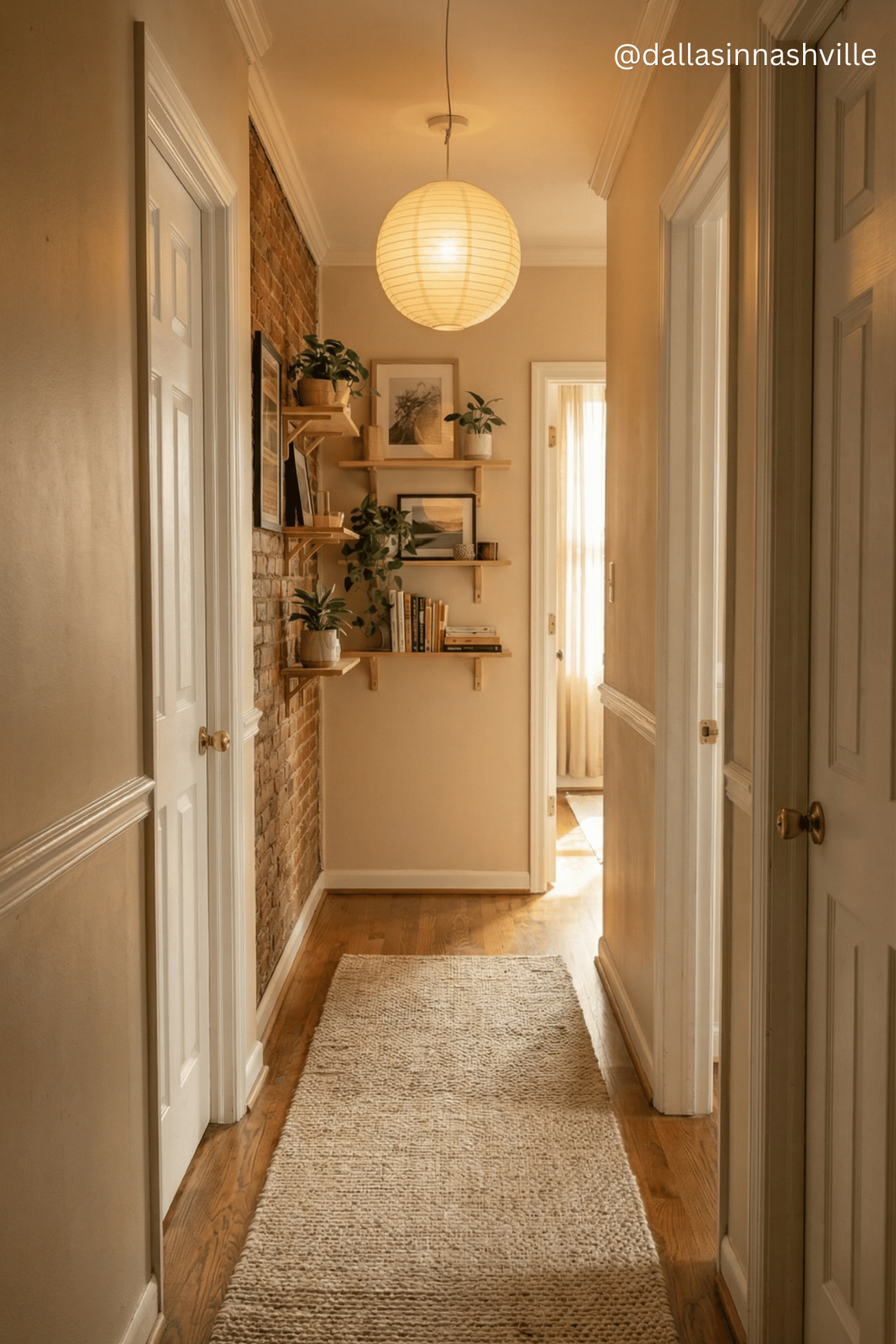
Hallways are one of those spaces that almost always end up last on the decorating list. They are too narrow to feel like a real room, too short to justify much investment, and too in-between to ever feel like a priority. But if you walk through a hallway multiple times a day — and most of us do — it is affecting how your home feels whether you are paying attention to it or not.
The good news is that a small hallway is one of the easiest spaces in a home to transform because it takes so little to make a noticeable difference. Here are eight changes that actually work.
1. Choose a Light or Dramatically Dark Paint Color — Skip the Middle
Paint color is the single highest-impact change you can make to a small hallway, and the rule is simple: go light or go bold, but avoid mid-tones. Medium grays, beige, and muddled in-between colors tend to make a narrow hallway feel smaller and duller. A clean, crisp white or soft warm white reflects light back into the space and makes it feel noticeably more open. Think Benjamin Moore Chantilly Lace, Simply White, or White Dove for a bright, airy result that makes even a tight corridor feel bigger.
The opposite approach — going very dark — can actually work beautifully too. A deep navy, charcoal, or forest green on all four walls creates a moody, cozy effect that makes the narrow dimensions feel intentional rather than limiting. The trick is committing to one end of the spectrum or the other. If you are unsure, light always wins for making space feel larger.
2. Paint the Trim and Walls the Same Color
This is one of the most underused tricks in home decorating and it is especially effective in narrow spaces. When you paint the trim, baseboards, door casings, and walls all the same color, it eliminates the visual interruption that normally breaks up the wall. The eye travels further and faster through the space, which creates the illusion of more room. It also has an elegant, elevated look that photographs beautifully and reads as very intentional design. If you are painting your hallway white, paint every surface white — walls, trim, crown molding, baseboards, all of it.
3. Paint the Doors a Contrasting Color
Once the walls and trim are unified, the doors become an opportunity for a moment of personality. A dark contrasting door color — navy, charcoal, black, deep olive, or a rich earth tone — against crisp white walls is one of the most classic combinations in interior design, and it works especially well in hallways. The contrast draws the eye forward toward each door opening, which visually lengthens the corridor. It is a relatively small commitment since doors are easy to repaint, and the result looks like something out of a renovated brownstone or a well-styled townhouse.
4. Swap Out the Light Fixture for Something With Personality
Most hallways are lit by whatever builder-grade flush mount fixture was there when the house was built. It is usually plain, usually forgettable, and usually does nothing for the space. Replacing it with a fixture that has actual character — a satin brass flush mount, a small drum pendant, a statement globe light, or anything with a finish that complements the rest of your home — instantly elevates the whole hallway. A good light fixture draws the eye upward, which is exactly what you want in a narrow space because it emphasizes the ceiling height rather than the narrow width.
If you have the ceiling height for a pendant, even better. It gives the hallway a sense of vertical space and importance that a flat flush mount simply cannot achieve.
5. Layer in Secondary Lighting
One overhead light source is functional but flat. Adding a second layer of warm light — a wall sconce, a picture light above a piece of art, or a small lamp on a console table — creates depth and dimension that makes the hallway feel warmer and more finished. The layered light effect is one of the things that separates professionally decorated spaces from ones that just have furniture in them.
If the thought of hiring an electrician for sconce installation feels like too much, battery-operated wireless picture lights and plug-in sconces are genuinely good options that require no wiring at all. A plug-in sconce with a cord cover is a DIY-friendly alternative that looks just as intentional as hardwired once it is installed and styled properly.
6. Add Art to the Walls
Blank hallway walls are a missed opportunity. Art in a hallway does something important — it gives the eye something to rest on and move toward, which makes the space feel longer and more purposeful. A single large-scale piece of art on the longest wall is a bold, effective choice that makes a narrow hallway feel more like a gallery corridor. A gallery wall grouping works beautifully too, especially in a longer hallway where one piece might feel lost.
Keep the art frames relatively simple so they do not add visual clutter to an already tight space. Black frames, thin natural wood frames, or clean white matted frames against white walls all look crisp and considered without overwhelming the hallway. Landscapes, botanicals, and abstract prints all work well in corridors.
7. Add a Runner
A runner rug does a surprising amount of work in a hallway. It adds warmth, texture, and color at ground level, it protects high-traffic flooring, and — most importantly for a narrow space — it creates a visual line that draws the eye from one end of the hallway to the other, making the corridor feel longer. Choose a runner that leaves a few inches of flooring visible on either side; a runner that is too wide will make the hallway feel even narrower, and one that is too short will look disconnected from the space.
A flatweave runner is generally the most practical choice for a hallway because it lies flat, is easy to clean, and does not bunch underfoot. Geometric patterns, stripes running lengthwise, and simple solid textures all work well. Make sure to use a non-slip rug pad underneath for safety on hard floors.
8. Add a Plant
A plant in a hallway is one of the easiest ways to add life to a space that can easily feel like a passthrough rather than a real room. A tall, slender plant — a potted olive tree, a eucalyptus, a fiddle leaf fig, or a simple floor plant on a pedestal stand — adds vertical height and softness without taking up floor space in a meaningful way. It also brings the outside in, which is one of those design principles that never fails to make a space feel more welcoming.
If the hallway does not get enough light for a real plant, a high-quality faux version is a genuinely good alternative. The realistic faux olive trees and eucalyptus plants available now are convincing enough that most people will not look twice, and they require zero maintenance in a space where watering is inconvenient.
A Few More Tips Worth Knowing
Mirrors make a huge difference in a narrow hallway. A large leaning mirror or a well-placed wall mirror reflects light and creates the illusion of a doorway or additional depth. If wall art is not enough to fill your hallway, a mirror is the single most effective tool for making a tight space feel larger.
Keep the floor clear. Hallways that have shoes, bags, or clutter piled up on the floor feel significantly smaller and more stressful to walk through. A slim console table with a single drawer, a wall-mounted hook rail, or a small entryway bench with under-seat storage keeps the hallway functional without adding bulk to the floor plan.
Vertical lines elongate the space. Whether it comes from vertical board and batten paneling, a tall striped runner, a linear light fixture, or tall narrow art frames — anything that draws the eye up rather than across will make a narrow hallway feel less narrow. It is the same principle that makes vertical stripes on clothing look slimming; it works the same way on a room.
Hallways are small, which means even one or two of these changes goes a long way. They also tend to be one of the most photographed spaces in a home because they connect everything — and a hallway that looks good makes the whole house feel more put together.